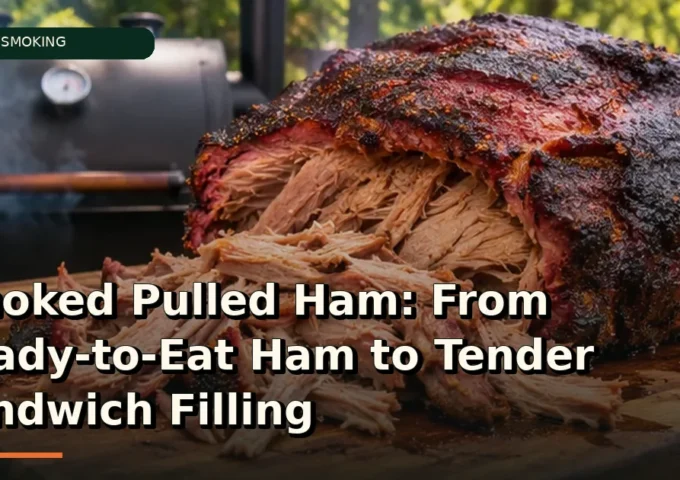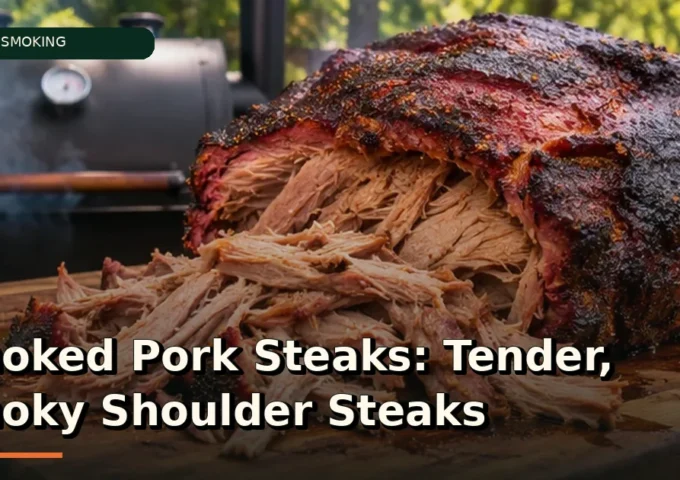

Smoking a pork butt at 250°F is a practical middle ground between very low-and-slow cooking and trying to rush a big piece of meat. The temperature is hot enough to move steadily through the cook while still allowing the surface to darken into a flavorful bark. The real finish line is tenderness, not a fixed number of hours.
250°F Smoked Pork Butt
Follow the steps as you cook, check off ingredients, or print the recipe alone.
Ingredients
Instructions
- Stabilize smoker near 250°F.
- Trim loose fat and season pork evenly.
- Smoke over indirect heat, keeping the lid shut as much as practical.
- If desired, wrap once the bark is well developed.
- Cook until a probe slides in easily at multiple points, commonly near 195–205°F.
- Rest safely and shred along muscle seams.
Cook’s notes: Tenderness, not elapsed time, determines when shoulder is ready for pulling. Whole-cut pork minimum safe temperature is 145°F with a 3-minute rest; that alone will not create pulled-pork texture.
What you need
- One bone-in or boneless pork shoulder/butt, roughly 6–9 pounds
- Salt, coarse pepper, paprika and your preferred barbecue spices
- Smoker capable of holding about 250°F, fuel and a drip pan
- A digital probe for the thickest part of the shoulder
- Butcher paper or foil if you choose to wrap
Set up the smoker
Preheat to 250°F and allow the cooking chamber to stabilize before loading the meat. Keep an ambient probe near grate level because lid thermometers may read a different temperature from where the pork sits. Use a mild-to-medium wood such as apple, cherry, oak or a blend; the goal is a clean stream of smoke rather than thick, bitter clouds.
Prepare and season
Trim only loose flaps and excessively thick hard fat. A thin fat cap is fine, but deep fat won’t turn into bark. Pat the meat dry, season every accessible surface and leave it on a tray while the smoker heats. If you salt the shoulder in advance, refrigerate it uncovered overnight; otherwise apply the rub just before cooking.
Cook through the stall
Set the shoulder on the grate and keep the lid closed except for necessary checks. Large pork shoulders often appear to stall while evaporation cools the surface. That is normal. For firm bark, leave it unwrapped longer. For a more predictable finish, wrap once the crust is set and the color is where you want it, commonly sometime around the middle of the cook. Paper preserves more surface texture; foil retains more moisture but softens the bark.
How long does pork butt take at 250°F?
Budget roughly 1–1½ hours per pound as a loose planning range, then add resting time and contingency. Actual duration varies with thickness, shape, bone, smoker accuracy and wrapping. A seven-pound shoulder can finish much faster or slower than an eight-pounder. Cook ahead and hold it safely warm if guests have a firm arrival time.
When is it ready to pull?
The meat is ready for pulled pork when a probe slides into several thick areas with little resistance and the muscles separate easily; this often happens in the neighborhood of 195–205°F, but it is a texture target rather than a universal safe-temperature rule. USDA minimum safe temperature for whole-cut pork is 145°F with a three-minute rest, yet shoulder cooked only to that point will not have the shreddable texture expected from pulled pork.
Rest, shred and serve
Rest the wrapped shoulder until it is comfortable to handle while keeping it out of the food-safety danger zone. Pull apart along the muscle seams, discarding hard fat and connective tissue. Taste before adding sauce; the rendered juices and seasoned crust may be enough. Refrigerate leftovers promptly in shallow containers.
Common mistakes
- Chasing the clock: start with a time estimate but finish by feel
- Opening too frequently: repeated lid lifts create temperature swings
- Wrapping too early: the bark can turn soft before it develops
- Heavy smoke: poorly combusted smoke can taste harsh
- Skipping the rest: rushed pulling wastes moisture and makes handling harder
FAQ
Can I smoke pork butt at 225°F instead?
Yes, but expect a longer cook with more time variability. A steady 250°F is a sensible default.
Should fat face up or down?
Protect the side facing your smoker’s strongest heat; the best orientation depends on where the heat enters your cooker.
Is bone-in better than boneless?
Both work. Bone-in can help the shoulder hold its shape; boneless is easier to portion and may cook less uniformly if not tied.
Related cooking: Chuck roast versus brisket and smoked baked beans.